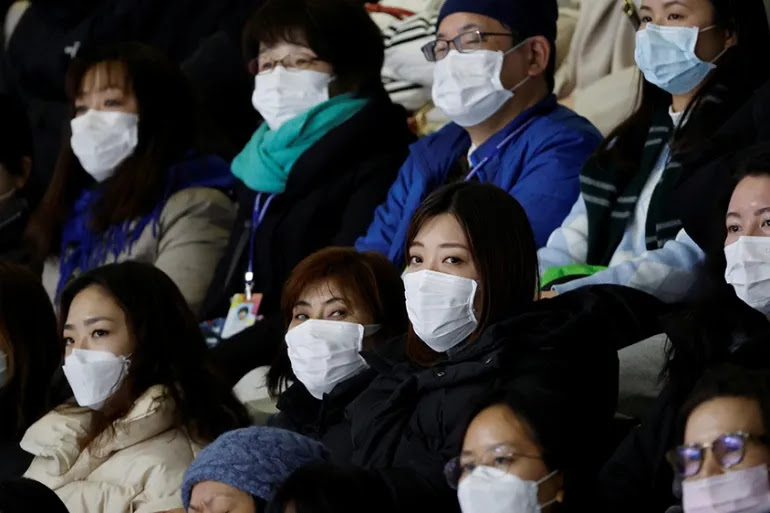
Summary: Most experts from Geneva to Hong Kong agree that masks offer some imperfect protection to the wearer, but they do stop carriers of the coronavirus from giving it to anybody else.
Global supply of masks is limited. Governments and societies must choose between (i) trying to get a mask on everyone's face to prevent transmission and (ii) accepting an outbreak will come and save stock up for healthcare staff and the sick.
****
First of all, the facts. They don’t conflict with each other as they may first appear.
1) CDC and WHO advise that wearing a face mask improperly won't protect the wearer. Of course. Hooking your sunglasses on your top won’t protect your eyes from the sun either.
2) Wearing a face mask alone won't fully protect the wearer: the eyes are still unprotected and can come into contact with infected droplets.
3) Many governments (eg Singapore’s) recommend people showing symptoms to wear a mask so they wouldn’t infect other people e.g. when they cough or sneeze.
4) This coronavirus is known to have an incubation period. For up to 14 days, an infected person could be going about their life before any symptom show up.
5) If everyone's wearing a mask, then those who have caught the virus but haven't been showing symptoms have a much lower chance of infecting others: droplets can infect people through their eyes, but they almost certainly come out of noses and mouths which face masks would cover.
This is the approach publicly recommended by health experts in Hong Kong eg Prof Pak-Leung Ho as the FT quoted. It is also the approach a large proportion of Hongkongers chose to follow despite what the government said.
Indeed, it was on the same ground Prof Ho recently advised against wearing a certain type of N95 masks that filters air that goes in but not the air that goes out.
6) This is summarised succinctly by Dr Michael Ryan, WHO’s executive director for emergencies: “masks don’t necessarily protect you, but they do - if you have the disease - stop you from giving it to anybody else.”
7) If a government advises universal mask-wearing, its people may expect it to secure supply at price similar to pre-crisis levels.
[This is, of course, against economics. Who’s paying for overtimes? If new factories were built, who is paying for the capital costs? And what about risk premium in investing in new factories?]
8) The world can produce around 40m face masks per day before Jan. China accounts for around half of that. Taiwan was 3rd largest and is now 2nd largest producer. Both have effectively stopped exports. So did major producers like Thailand and South Korea.
To put things into context: Taiwan’s population is 23m; China’s 1,386m.
9) Therefore I can understand why many governments want to reserve limited supply for their medical staff and discourage mass use of face masks. Singapore is one of the few that has been honest with its citizens on this.
10) When governments in Mainland China, Taiwan and now Korea recommended universal mask-wearing, they also introduced measures to ramp up production.
11) Taiwan’s fellow market democracies may learn more from studying its case than China’s. The government there bought mask-making machinery and then gave them to existing manufacturers in return for face masks of the same value. Effectively, a government-brokered financing lease. This way it managed to expand daily production from 4m to 10m within a month.
12) Hong Kong’s government never officially recommended universal face mask wearing. Its leader Carrie Lam even tried to tell civil servants not to wear them "unless they feel unwell" - but the next day, if my memory served me well, half of the officials at a press conference she chaired donned a mask. Hongkongers chose to listen to experts, not unelected politicians.
They learnt it the hard way: Hong Kong saw 299 or 38.6% of the global death toll from 2003 SARS. Once bitten, twice shy.
13) As a Hongkonger myself, I wish no other country had to learn lessons the same way.
14) So how has Hong Kong been getting its masks? Its own production - run by the prison service to supply government agencies - was a paltry 50,000 per day for a population over 7m. But when prices skyrocketed from pre-crisis $1 (HKD, same henceforth) each to $10-20 each, the private sector and civil society came to the rescue.
15) Therefore, unless France has enough productive capacity for its own medical staff, I think its decision to requisition face masks will only exacerbate the shortage in that country. Now, no supplier in their sound mind will want to route their deliveries through France.
When incentives are right, market and individuals are usually better at buying stuff and bringing them home.
16) Admittedly, many of these masks bought by Hongkongers at higher-than-usual prices were baseline stock held in other countries eg Germany, Honduras, UAE, Turkey. Now they may need them a lot more than they thought.
17) Hong Kong is a relatively rich place. As the coronavirus goes global, it (and other East Asian countries that chose universal mask-wearing) may have priced medical staff in poorer countries out of essential protective gear. That’s apparently also why the WHO does not advise universal mask-wearing.
18) Back in early Feb, my friends and I were trying to buy face masks for re-export from UK wholesalers. Most were already telling us they had no stock to sell us because their order books have already been block-filled by the NHS.
I get that the UK government / NHS might have wanted to appear inactive so that they don’t stoke a panic. But, in fact, they don’t seem to be that inactive.
19) Because the NHS has been stocking up, I suspect whatever you can still get on the high street these days are parallel-imported overseas. You probably won’t be competing with the NHS.
20) So, to wear or not to wear? I’m no health professional. All views in this note are that of a layman, ie my own.
My take is that wearing a mask wouldn’t hurt you. If you’ve never worn one, it’ll be good to find and watch a video online that teach you how to wear it properly beforehand. It probably would reduce the risk you face more when you’re on a plane or in the tube. In any case, a face mask almost certainly keeps some of the air pollutions in the tube out.
But a humble surgical mask won’t make you virus-proof. It wouldn’t and shouldn’t replace good hygiene either.
P.S. I’ll try my best to stay at home if I show symptoms. If I have to go out, I’d wear a mask to avoid infecting others, even if at the end it turns out to be just common cold.
****
Also on Facebook
Original inspiration:
Global supply of masks is limited. Governments and societies must choose between (i) trying to get a mask on everyone's face to prevent transmission and (ii) accepting an outbreak will come and save stock up for healthcare staff and the sick.
****
First of all, the facts. They don’t conflict with each other as they may first appear.
2) Wearing a face mask alone won't fully protect the wearer: the eyes are still unprotected and can come into contact with infected droplets.
3) Many governments (eg Singapore’s) recommend people showing symptoms to wear a mask so they wouldn’t infect other people e.g. when they cough or sneeze.
4) This coronavirus is known to have an incubation period. For up to 14 days, an infected person could be going about their life before any symptom show up.
5) If everyone's wearing a mask, then those who have caught the virus but haven't been showing symptoms have a much lower chance of infecting others: droplets can infect people through their eyes, but they almost certainly come out of noses and mouths which face masks would cover.
This is the approach publicly recommended by health experts in Hong Kong eg Prof Pak-Leung Ho as the FT quoted. It is also the approach a large proportion of Hongkongers chose to follow despite what the government said.
Indeed, it was on the same ground Prof Ho recently advised against wearing a certain type of N95 masks that filters air that goes in but not the air that goes out.
6) This is summarised succinctly by Dr Michael Ryan, WHO’s executive director for emergencies: “masks don’t necessarily protect you, but they do - if you have the disease - stop you from giving it to anybody else.”
****
So, where does the world stand now? We may want to observe the following:
So, where does the world stand now? We may want to observe the following:
[This is, of course, against economics. Who’s paying for overtimes? If new factories were built, who is paying for the capital costs? And what about risk premium in investing in new factories?]
8) The world can produce around 40m face masks per day before Jan. China accounts for around half of that. Taiwan was 3rd largest and is now 2nd largest producer. Both have effectively stopped exports. So did major producers like Thailand and South Korea.
To put things into context: Taiwan’s population is 23m; China’s 1,386m.
9) Therefore I can understand why many governments want to reserve limited supply for their medical staff and discourage mass use of face masks. Singapore is one of the few that has been honest with its citizens on this.
10) When governments in Mainland China, Taiwan and now Korea recommended universal mask-wearing, they also introduced measures to ramp up production.
11) Taiwan’s fellow market democracies may learn more from studying its case than China’s. The government there bought mask-making machinery and then gave them to existing manufacturers in return for face masks of the same value. Effectively, a government-brokered financing lease. This way it managed to expand daily production from 4m to 10m within a month.
12) Hong Kong’s government never officially recommended universal face mask wearing. Its leader Carrie Lam even tried to tell civil servants not to wear them "unless they feel unwell" - but the next day, if my memory served me well, half of the officials at a press conference she chaired donned a mask. Hongkongers chose to listen to experts, not unelected politicians.
They learnt it the hard way: Hong Kong saw 299 or 38.6% of the global death toll from 2003 SARS. Once bitten, twice shy.
13) As a Hongkonger myself, I wish no other country had to learn lessons the same way.
14) So how has Hong Kong been getting its masks? Its own production - run by the prison service to supply government agencies - was a paltry 50,000 per day for a population over 7m. But when prices skyrocketed from pre-crisis $1 (HKD, same henceforth) each to $10-20 each, the private sector and civil society came to the rescue.
- Small pharmacies got them overseas, probably at a higher price than usual wholesale price, and sold them with a high margin.
- Large pharmacy chains like Watson's sourced them overseas and sold them at cost, earning praise and brand value.
- Politicians and activists of all shades sourced them from around the world. Did Joshua Wong, that activist of international fame, not bring masks back from Honduras? There’s no better time to prove to the people that your lot is more competent than the other.
15) Therefore, unless France has enough productive capacity for its own medical staff, I think its decision to requisition face masks will only exacerbate the shortage in that country. Now, no supplier in their sound mind will want to route their deliveries through France.
When incentives are right, market and individuals are usually better at buying stuff and bringing them home.
16) Admittedly, many of these masks bought by Hongkongers at higher-than-usual prices were baseline stock held in other countries eg Germany, Honduras, UAE, Turkey. Now they may need them a lot more than they thought.
17) Hong Kong is a relatively rich place. As the coronavirus goes global, it (and other East Asian countries that chose universal mask-wearing) may have priced medical staff in poorer countries out of essential protective gear. That’s apparently also why the WHO does not advise universal mask-wearing.
****
What about here in London?
What about here in London?
I get that the UK government / NHS might have wanted to appear inactive so that they don’t stoke a panic. But, in fact, they don’t seem to be that inactive.
19) Because the NHS has been stocking up, I suspect whatever you can still get on the high street these days are parallel-imported overseas. You probably won’t be competing with the NHS.
20) So, to wear or not to wear? I’m no health professional. All views in this note are that of a layman, ie my own.
My take is that wearing a mask wouldn’t hurt you. If you’ve never worn one, it’ll be good to find and watch a video online that teach you how to wear it properly beforehand. It probably would reduce the risk you face more when you’re on a plane or in the tube. In any case, a face mask almost certainly keeps some of the air pollutions in the tube out.
But a humble surgical mask won’t make you virus-proof. It wouldn’t and shouldn’t replace good hygiene either.
P.S. I’ll try my best to stay at home if I show symptoms. If I have to go out, I’d wear a mask to avoid infecting others, even if at the end it turns out to be just common cold.
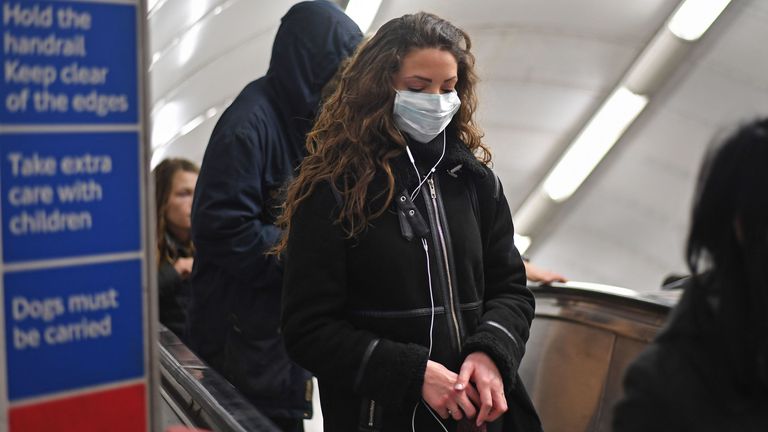 |
| A mask-wearer at a London airport. Source: Sky |
Also on Facebook
Original inspiration:
- The Financial Times, "Hong Kong’s coronavirus response leads to sharp drop in flu cases", 5 March 2020.